

The role of Human Resources has undergone a fundamental transformation over the last decade. Once viewed primarily as a support or compliance-driven function, HR is now expected to play a central role in shaping organizational strategy, culture, and long-term performance. This shift has elevated the importance of HR leadership and strengthened the demand for leaders who can bridge people strategy with executive decision-making.
Talent shortages, evolving workforce expectations, hybrid work models, and increasing competition for skilled employees have pushed people strategy to the forefront of executive discussions. As a result, HR influence in the C-suite is no longer optional, it is a critical component of sustainable business performance.
Yet despite this shift, many HR leaders still struggle to gain sustained influence in the C-suite. While they may be invited to leadership meetings, their input is often tactical rather than strategic. The difference between HR being “present” and HR being “influential” lies in how effectively HR leaders align their expertise with business priorities, demonstrate measurable impact, and build long-term trust with executive stakeholders.
At IHR, this challenge is addressed head-on. Their work focuses on helping HR leaders elevate their role, strengthen strategic HR leadership, and position people strategy as a core driver of business success, employer branding, and long-term employee retention.
Why HR Leadership Needs a Strategic Seat at the Executive Table
Growth strategies fail without the right talent. Transformation initiatives stall without leadership alignment. Culture deteriorates when people decisions are disconnected from business goals.
When HR leadership strategy is embedded early in strategic discussions, organizations gain clarity on questions such as:
- Do we have the leadership capability to support this growth plan?
- What skills will be required in the next 12–24 months?
- How will this change impact engagement, employee retention, and culture?
- What workforce risks could undermine execution?
Forward-thinking executives increasingly recognize that HR strategy is business strategy. This is where HR executive leadership becomes essentia ensuring workforce planning, leadership development, and culture strategy support the broader business vision.
IHR supports organizations in reframing HR’s role from operational executor to strategic advisor, ensuring people decisions reinforce, rather than hinder, organizational objectives. This may include aligning workforce initiatives with long-term hiring strategies such as direct hire staffing services, interim staffing, or integrated workforce management solutions.
The Evolution of Strategic HR Leadership Expectations
Modern HR leaders are expected to operate at a higher level of complexity than ever before. The function now sits at the intersection of leadership development, organizational design, compliance, culture, and brand reputation.
This evolution means HR leaders must balance multiple roles:
- Strategic advisor to the executive team
- Guardian of culture and values
- Architect of talent and leadership pipelines
- Risk manager for workforce-related exposure
- Champion of employee experience and employee retention
As organizations scale, HR leaders often collaborate with executive recruiters and workforce partners to secure leadership talent aligned with organizational priorities. IHR works with HR leaders to bridge this gap by aligning HR capabilities with executive expectations and enterprise-level priorities.
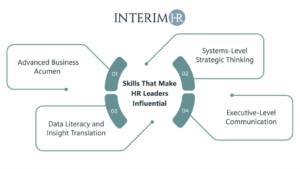
Skills That Make HR Leadership Influential in the C-Suite

Advanced Business Acumen as a Core HR Leadership Skill
To influence the C-suite, HR leaders must understand how the business operates financially and strategically. Strong HR leadership skills includes familiarity with revenue drivers, cost structures, margins, and growth levers. When HR recommendations are framed in terms of risk mitigation, productivity gains, or long-term value creation, they gain immediate traction.
Systems-Level Strategic Thinking for HR Leadership Strategy
Influential HR leaders think holistically. They understand how talent, culture, leadership, and structure interact as a system. Rather than addressing isolated HR issues, they connect people initiatives to broader organizational outcomes and reinforce long-term culture strategy.
Data Literacy and Insight Translation for HR Executive Leadership
Data alone does not create influence. The ability to translate workforce data into executive insight is what distinguishes effective HR leadership strategy. Metrics around turnover, engagement, performance, and workforce planning become powerful when tied to strategic risks and opportunities.
Executive-Level Communication That Builds HR Influence in the C-Suite
Clear, confident communication is essential. HR leaders must be comfortable presenting to senior executives, challenging assumptions respectfully, and articulating complex people issues succinctly.
This ability to communicate strategic insight is often the defining factor behind HR influence in the C-suite.
How to Communicate HR ROI to Leadership and the C-Suite
One of the most persistent barriers to HR influence is the perception that people initiatives lack measurable return. This perception often exists because HR outcomes are not consistently framed in business terms.
Shift from Activity to Impact in Strategic HR Leadership
Executives are less interested in how many programs HR runs and more interested in what those programs achieve.
For instance:
- Leadership development should be linked to succession readiness and reduced leadership risk.
- Engagement initiatives should be tied to productivity, employee retention, and customer outcomes.
- Employer branding efforts should demonstrate reduced hiring costs and improved talent quality.
Quantifying Employee Retention Value in HR Leadership Strategy
Employee retention is one of the most powerful ROI narratives available to HR. Replacing experienced employees is costly, not only financially, but in terms of lost knowledge and momentum.
Using Scenario-Based Storytelling to Influence Executive Decisions
Presenting “what if” scenarios, such as projected attrition during growth phases or leadership gaps following expansion, helps executives understand the future implications of today’s decisions.
These narratives strengthen HR leadership strategy by linking people initiatives directly to business outcomes.
Building Long-Term Trust With Executives Through Strategic HR Leadership
Influence is sustained through trust, not one-time wins. HR leaders who maintain credibility over time do so by consistently aligning with executive priorities and delivering results.
Consistency and Reliability as Foundations of HR Leadership Credibility
Executives trust HR leaders who provide clear guidance, meet commitments, and avoid overpromising. Reliability builds confidence in HR’s judgment.
Balanced Advocacy in HR Executive Leadership
Effective HR leaders advocate for employees while maintaining objectivity. They present people-related risks honestly, even when the message is uncomfortable, and support leadership decisions with integrity.
Deep Stakeholder Understanding to Strengthen HR Influence
Each executive has different priorities. HR leaders who tailor their messaging to address financial, operational, or cultural concerns strengthen relationships and influence outcomes.
Conclusion: Strengthening HR Leadership Influence in Business Strategy
The path to C-suite influence is not about redefining HR’s importance, it’s about demonstrating it.
Today’s most effective HR leaders operate as strategic partners who connect people, culture, and performance into a cohesive business narrative. They align employer branding, leadership development, and employee retention initiatives with broader organizational goals.
IHR partners with organizations and HR executives to elevate HR’s role, strengthen strategic HR leadership, and align people strategy with enterprise priorities. Through workforce expertise including leadership hiring support, interim staffing, and integrated workforce management solutions, IHR helps organizations translate HR strategy into measurable business impact.
FAQs About HR Leadership Influence in the C-Suite
How can HR gain more influence at the executive level?
HR gains influence by aligning people initiatives with business objectives, communicating measurable ROI, and strengthening HR leadership skills that resonate with executive priorities.
Developing strong business acumen, reinforcing employer branding, improving employee retention, and consistently delivering results that support organizational performance are essential components of effective HR executive leadership.